A New Chapter

In a whirlwind, a new chapter of my life begins; now I am a married woman. Seven weeks ago, I was headed home; I couldn’t wait. International and domestic travels, wedding appointments and planning, quality time with family and friends, doggie time with my fur-nephew, Christmas, wedding, honeymoon, celebrating a new year, meeting with SAMS (my mission agency), back home in Cape Town—all done within six weeks. No wonder I’m tired and way behind in my thank-you cards and unpacking. (I won’t even mention the messy state of my flat and all the weeds in my garden.)

But I’m excited to begin this new chapter of my life, as I add the title of “wife” to my seasoned labels of daughter, sister, and friend. I wonder what the first year of marriage will hold for us; I know it will entail a lot of change.

IMG_5138Wayne and I are so blessed and so happy. Sometimes I still can’t believe how much God has blessed me with such a wonderful husband. I still pinch myself when I think about our wedding, which surpassed all of my dreams. From the time I woke up to the time I went to bed, I enjoyed every moment of our special day. It was a day of pure joy. I will never forget the feeling of happiness I had when I was able to get a glimpse of all our guests sitting in the church; in my mind I thought, Wow. All these people love us. How many people have the honour and privilege of being surrounded at one time by so many people who love them? We are so blessed!

We are so grateful for our family and friends who helped to make our day so special and who continue to share in our happiness. We love you all.

I See Her in Them

South Africa LadiesEvery time I see an African domestic (maid) with white children, a wave of sadness comes over my heart. I understand the cultural dynamics, the legacy of race in this country, and the economic inequity to know the reason for and, in a way, the necessity for these domestics. But my heart feels sad all the same when I see situations as I described.

I think I know why I feel the way I do. My grandmother on my father’s side was a domestic. Grandma was an educated lady. She was a teacher, but when she got married, as was the custom of the day, she stopped working to stay at home as a housewife. Eventually, for her family to earn extra money, she worked as a maid for a doctor’s family. In Jim Crow South, this was one of the few things black women could do to earn an income. Thankfully, the doctor and his family treated Grandma well; and she talked fondly about them until the day she died.

My great-grandmother on my mother’s side was a domestic. She was a formidable, God-fearing woman. She raised half of the children–both black and white–in her small Southern town. When she passed away, there was standing room only at her funeral, as the entire town, all of her children, turned out to pay tribute.

My great-grandmother on my father’s side was an ex-slave. Queen was her name; and according to the family stories, her named suited her. When freed, she was given land in her own right. That land is still in my family today.

So I think the reason why I feel sad when I see African domestics taking care of white children is because I see my grandmothers in them. I wonder if they have good situations in caring families, as my two grandmothers had, or if they are treated badly. I wonder what children they have of their own whom they are struggling to support, to give a leg up in the world. I wonder if they are happy. I wonder if they are really queens underneath their doeks. I think my grandmothers would be proud to know that their hard work has not only paid off in their children but also in their children’s children and in their children’s children’s children. I wonder what my grandmothers would think of me. What would they think of my serving as a missionary in Africa? I hope they would be proud. I like to think that they would.

Surprised by Mama

When the taxi rolled away, I saw her standing there–this typical Xhosa mama with a cap on her head, supported by crutches because she had only one leg, with her blanket neatly packed on one side and her bag of belongings on the other side. My heart sank as I thought, Oh, no. Is this one of the trainee trainers for our conference? This lady doesn’t look she can be a trainer. Can she can grasp the material? Can she lead?

mama LucyAs the conference went on, I had to repent, as Mama Lucy taught me a lesson in not judging a book by its cover. First of all, she was the first one of our trainee trainers to volunteer to lead a workshop. Second of all, she grasped the material, studied it, and prepared it, conveying it well to others. Third of all, she had a compassionate heart. She noticed the newcomers and reminded me to give them their material. She spoke up for those who were confused or who didn’t know how to express the questions they had.

In African tradition, we address older ladies as “mama.” It’s a sign of honour, respect, affection, and a sort of recognition that they are “mamas” to us all. Mama Lucy has six biological children, and I am sure she is a wonderful mama to them all; but she taught her American daughter a lesson that she won’t forget anytime soon. Thank you, Mama Lucy.

Foreign

Not long ago, I completed a Rooted in Jesus Junior conference, the first one that I have overseen in a rural diocese. I was in a Xhosa speaking community. For the first time in many months, perhaps all year, I haven’t felt so foreign than I did during that conference. The people struggled to understand me. I struggled to understand them–their English, their protocol, their (extreme) concept of “African time.”

The translator took liberties translating me. My sentences were brief, but she would take several minutes to translate them and embellish what I was saying. That I knew. Nothing ever started on time. We always started at least an hour late, but it was amazing how we caught up with the time, rarely going over our ending time by ten minutes.

For the most part, I do just fine in Cape Town. The culture there is Western enough to make adapting somewhat easy, but I struggle in the rural communities.

At one time, early in the conference, I asked myself, “God, why am I here? Am I getting through or just wasting everyone’s time? I think my being here is a mistake.” I felt God calling to my mind one of the scripture passages I teach on the course, Jeremiah 1:4-8 (NIV), which is about the call of Jeremiah:

The word of the Lord came to me, saying,

“Before I formed you in the womb I knew you,
before you were born I set you apart;
I appointed you as a prophet to the nations.”

“Alas, Sovereign Lord,” I said, “I do not know how to speak; I am too young.”

But the Lord said to me, “Do not say, ‘I am too young.’ You must go to everyone I send you to and say whatever I command you.  Do not be afraid of them, for I am with you and will rescue you,” declares the Lord.

I felt God saying to me, don’t say that you can’t speak because you are a foreigner. I have appointed you to be here before you were even born. I will give you the words to say.

After this, nothing miraculous happened. I didn’t instantly start speaking Xhosa. The translator continued to take liberties. I didn’t have any warm and fuzzy feelings that everything would be ok, but I tried with the Lord’s help to trust that God was working behind the scenes, in ways I didn’t know or couldn’t see. I could trust God to transcend our language and cultural differences. It was a test of trust, to be sure!

Mthatha RinJ Junior Delegates

At the end of the conference, several people shared testimonies about how the conference has changed their understanding of their view of children and their understanding of discipling children. Here are some:

  • “I used to think only one of my Sunday School children could pray. Now I know that they all can pray.”
  • “I used to think that the Holy Spirit was only for adults. Now I know that the Holy Spirit is for everyone.”
  • “I used to be bitter towards my youngest child because his father left me because he was born. I used to beat him. I now understand that God loves my child, that he is special to God, and that I should love him too. God has put love in my heart for my child.”

I give thanks to our God who transcends all languages and cultures, helping us to understand one another and binding us in love.

Taxis

I’m afraid I haven’t been very good about posting to my ministry Facebook page more details about each day’s prayer item on my South African prayer calendar.

Here is the prayer request I had meant to post for Sunday. I will run it in full below since “taxi wars” are currently occurring in Cape Town. Please pray for the safety of all passengers, drivers, and people passing by

Taxis and Taxi Drivers
Taxis are the main form of public transportation in South Africa. These taxis aren’t the yellow cabs that we are accustomed to in the U.S. They are more like a minibus. Taxi culture is quite interesting. Drivers often name their taxis; here are a few names I have seen around Cape Town: Lonely Boy, Banana Split, and God Only Knows. In addition, taxis often sport the name of their Cape Town Taxifavourite football team or have some catchy logo or writing on the back. Taxis have no designated route; this inscription on the back of a taxi I saw sums it up “this taxi stops without warning at anywhere, at anytime.” As far as I know, there are issues around regulating the taxis, and some taxis are ill equipped to be on the road. Some drivers are part of a conglomeration. Sometimes “taxi wars” ensue between certain conglomerations, and some drivers get killed. Oftentimes, these taxi wars are gang related too.

Prayer Calendar

For months, I have been wanting to put together a prayer journal for South Africa. When I ask my supporters to pray for South Africa and my work here through SAMS and Growing the Church, I often think my request is rather vague, as many people don’t know where to start or for what to pray. (I know I would find it difficult to formulate prayers for such a request.) So I have put together this prayer calendar to help guide our prayers. I hope you will find this helpful as you continue to pray for this country and my ministry. Don’t be fooled—your prayers do make a difference and serve as the foundation of my work. Your prayers do not have to be long, but it would be great if you could commit to pray for the appropriate item of the day, even if it is just for five seconds. (Short prayers work just fine!) Thank you for your commitment to pray for this wonderful country and for me.

You can download a printable Sept 2014 Prayer Calendar to stick on your fridge or to put in your Bible. To find out more about each prayer item, please visit the SA Prayer Calendar on this site at https://nicolecorlew.com/sa-prayer-calendar/

Thanks for your prayers!

For the Love of Dickens

For the past three weeks, I have been intentional about carving out more rest and relaxation in my life. I feel as though God is calling me into a season of abiding, into a time of slowing down, spending more time with him, focusing on relationships, and engaging in things I enjoy most.

I have rediscovered my love of Henry Purcell and have been listening to him every day. I have been watching episodes of my favourite show, I Love Lucy, and laughing all over again at the shenanigans and antics of Lucy and Ethel. (Last week, when I was battling a nasty sinus infection, I wish I had a bottle of Vitameatavegamin to “spoon my way back to health.”)

http://www.youtube.com/watch?v=P0cQ_XFj_34

And I have been reading and reading.

For some time, I have been thinking about the book David Copperfield, and I decided to read it again. Years ago, when I first read David Copperfield, I loved it. This time it’s like I’m in the middle of the story, living it out. I know many people may groan over Dickens, perhaps not having not-so-good memories of him in high school or college; but I think Dickens is one of those timeless authors who totally captures the human experience and who deals with social justice issues that are still relevant to us today.

young Charles Dickens
Young Charles

I could feel little David’s loneliness, fear, and lack of love and being wanted when he was left an orphan at an early age. (Maybe since I live in a society that has thousands of orphans, many of whom feel unloved and rejected, I can relate more to David’s experience.) My heart ached for him when he was shipped off to an awful boarding school and was regularly beaten. My heart leapt for joy when his aunt took him in and offered him her love and protection. I laughed out loud when David, as a young man, fell in love for the first time, living and breathing in his darling Dora, whom he “loved to distraction.” (Yes, our first love is always like that!)

Charles Dickens famously said that out of all the books he had written, David Copperfield was his favourite son; and I couldn’t have agreed with him more.

Remembering

Last night, during a spiritual exercise with my “cell” (small) group, I thought about some people who had played a special role in my life. Who immediately came to mind was my dear friend John Mogabgab, who recently passed away. If you had the blessing and honour to know John, then you know how hard it is describe him, this marvelous man with a gentle spirit and a wonderful wit, a beard like a desert father, a pupil and scholar of Henri Nouwen, and the founding editor of Weavings. Yet, last night, I realised a special gift John and his wife, Marjorie, gave me and that was the gift of listening to God. The two of them, through their contemplative spirituality, showed me through practice and example how to be intentional about listening to God. Although I don’t do a very good job setting aside quiet time to just listen to God, I am grateful for this lovely and essential gift John and Marjorie gave me, and I’m trying to cultivate in my life a pattern of listening.

On another and a very surprising note, I also thought about the math teachers I had in high school and at university. While listening to a friend share about her child’s struggle with math and with the school’s frequent change of math teachers, I realised for the first time in my life how blessed I was to have the math teachers I had. No doubt, my high school and university friends can’t believe what they are reading, as I struggled so much and complained endlessly about math. However, with one exception, all the math teachers I had were good at teaching their subjects and were so patient with me, going beyond the call of duty to offer me special help. Geometry gave me the hardest time, but my teacher regularly tutored

geometryme after school. I don’t even remember his name; it has been that long ago, but I remember his face and his kindness. Honestly, if I didn’t have helpful math teachers, my academic life could have noise-dived; and I could have become so discouraged. Who would have known that twenty-plus years later, I would give thanks for the math teachers in my life?

I continue to live into my life of Ubuntu, as I continue to realise that my “humanity is caught up, is inextricably bound up in yours”—my dear friend John and my math teachers.


Helpless But Not Hopeless

I held her in my arms and let her cry. I didn’t know how to pray for her. I couldn’t find the words. I let her cry, and I cried with her.

Let’s call her LeThabo. At the Friday Night Youth Celebration at Anglicans Ablaze, we had a special time of ministry and prayer. I served on the ministry team. A young girl, probably around 15 or 16, came up to me for prayer. “My mother has HIV,” she whispered in my ear, “and we are poor. I’m scared.” And then she broke down in tears. How to pray for her? I thought. I was so overcome with, why, God, why? LeThabo’s story is so common here; she represents thousands upon thousands of South African young people. I prayed for her mom’s healing; I prayed for her and her siblings, but it felt fake. I was so angry. Then I could no longer find the words. We wept together, and I found myself saying to her, it’s OK to cry, just let it all out. God understands your pain and weeps with you.

I felt so helpless as I held LeThabo in my arms, but neither one of us was hopeless. I don’t understand why there is so much pain and suffering in South Africa and in the world. I don’t understand why teenagers, whose greatest concern should be their studies and who should be blossoming into life, have to bear so much pain and responsibility. It doesn’t seem fair; it’s not fair.

At the times when we can’t find the words to pray, we can weep with our sisters and brothers in their pain and trust that God hears our prayers of tears.


Trust in him at all times, you people;

pour out your hearts to him,

for God is our refuge.

–Psalm 62:8


The [Holy] Spirit helps us in our weakness. We do not know what we ought to pray for, but the Spirit himself intercedes for us through wordless groans.

–Romans 8:26


Humility

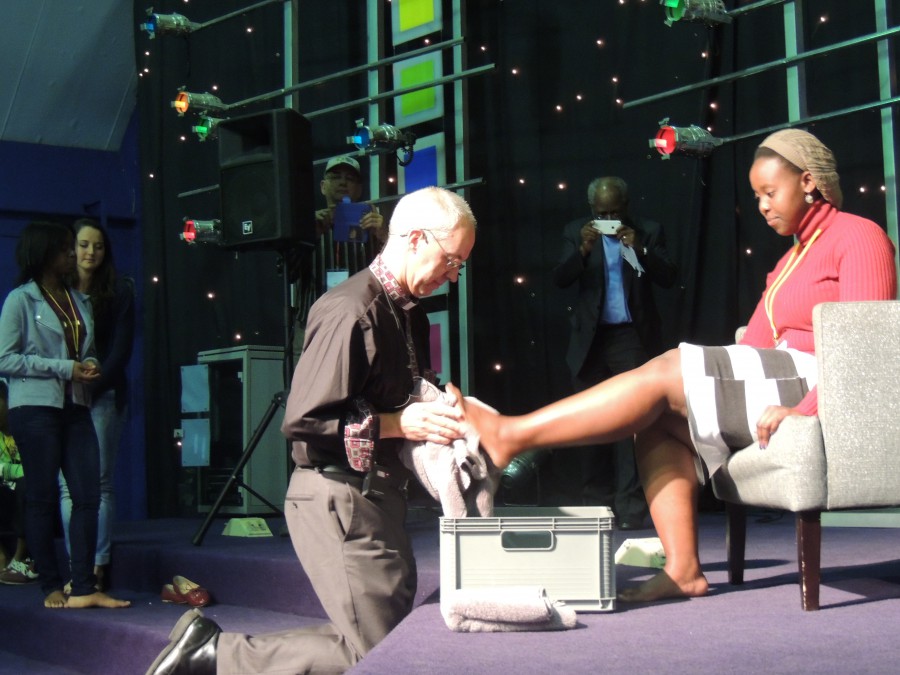
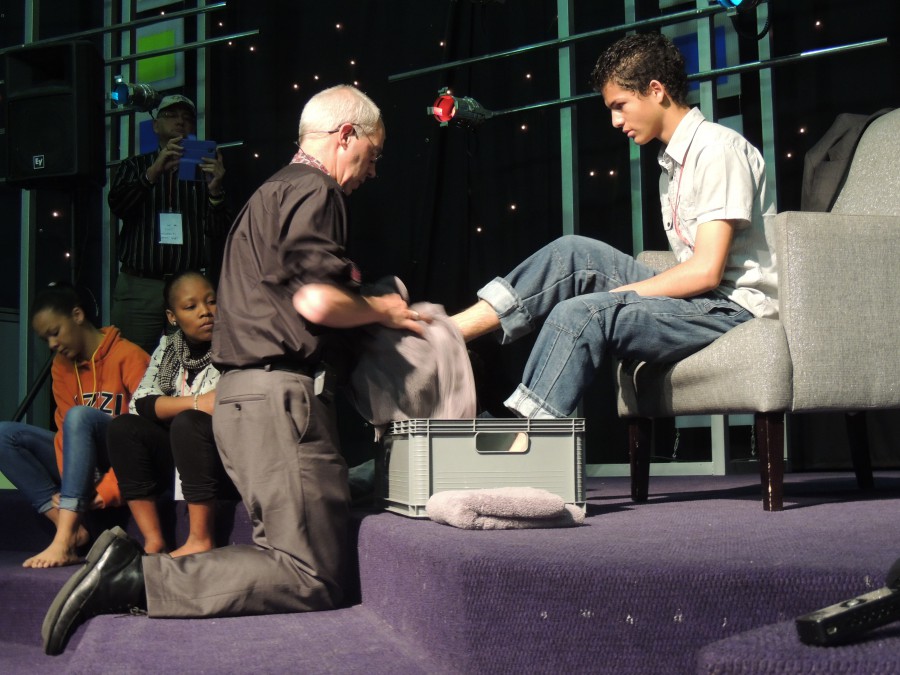
Archbishop Justin He washed their feet. Narrow and wide; male and female; shades of brown, black, and white—12 pairs of teenage feet, he washed. The head of the Anglican Communion, the Archbishop of Canterbury, Justin Welby, got on his knees, gently taking up a pair of feet to wash. Then he blessed the bearer of the feet.

How beautiful are the feet of those who bring good news.

I will never forget this day, when I had the absolute honour of overseeing the hosting of Archbishop Welby when he spoke to the youth at Anglicans Ablaze. His talk was real, vulnerable, relatable, encouraging. He spoke about how God used Paul and Barnabas’ disagreement over the young man Mark, who had deserted them on a mission, for good, helping to spread the Good News and how Paul later “re-commissioned” Mark, requesting his help on another mission. The archbishop tied this to our lives today, reminding us how God can use for good the mistakes we have made. Archbishop Welby also talked about how modern-day society, even himself at times, suffers from the “imposter syndrome”—the fear of having people know who we truly are on the inside, warts, fears, jealousies, muck, insecurities, desires, and all. If people really knew us, they wouldn’t like us.

Then, at the end of his talk, the archbishop washed 12 pairs of feet, demonstrating Christ’s love for his church. There was not a dryArchbishop Justin 2 eye in the room. You could feel God’s presence; it was the presence of love, nearly tangible, like a cloud. Archbishop Welby’s action was the act of love and a servant spirit. It was humility incarnate. I could sense God saying to us all, Go and do likewise.