A Most Special Gift

Birthday Pudding that Dad made. Yum!

Monday was my birthday, and I had a wonderful time celebrating with family and friends. I think it was the best birthday I have had as an adult. I got to spend my special day with my parents, my siblings, and some of my closest friends. Everyone wanted to make this day special for me, since it would be the last birthday I would spend with my loved-ones for a while. And it was indeed special.

The best gift I received came from my dad; it was a little autobiography of his life. On Father’s Day, I gave Dad the book My Dad: His Stories. His Words. It was a journal book in which Dad would answer questions about his life, from his childhood through adulthood. As I told dad, it was a “selfish gift” because it was really a gift for me, my siblings, and our future children. Dad was supposed to work on the book while I was away in South Africa, but he finished it up early and gave the completed work to me as a birthday present. The story of Dad’s life in his own words is a priceless gift that I will treasure for the rest of my life.

Reading Dad’s story was a reminder to me that my parents are human beings. Beginning in our teenage years, the image of our parents begins to transform into something of the “other.” For some, the image is negative; parents seem like a foreign species. For others, the image is positive; parents seem like perfect beings, like angels. The latter is how I viewed my parents for many years.

Celebrating my b-day with the two who gave me life

In my 30s I began to realize that my parents were not perfect; they have made mistakes like the rest of us. But Dad’s book also reminded me that my parents have experienced many ups and downs in their lives, that they have feelings, that they have joys, disappointments, frustrations, and dreams. Unfortunately for me, I often allow the label of “parent” to overshadow the humanness of my parents.

I don’t have children, but I think being a parent is the hardest “job” in the world; and I think it gets even harder as your children grow up. Eventually, you have to let them go. I don’t know my parents’ inner thoughts, but they are dealing with my upcoming move to South Africa with amazing faith, grace, and dignity. Without their support, love, and encouragement, I would never have the strength to follow God’s call to South Africa.

 

Sweet Sixteen

Junior Prom
Junior Prom. Look at that hair!

Earlier this year when I started preparing for my support raising talks, one thing hit me that I had never thought about: my 16th year of life played a pivotal role in my life’s journey.

No, it was not your typical teenage stuff—first kiss, driver’s license, and all of that; but three things happened to me that totally changed my world.

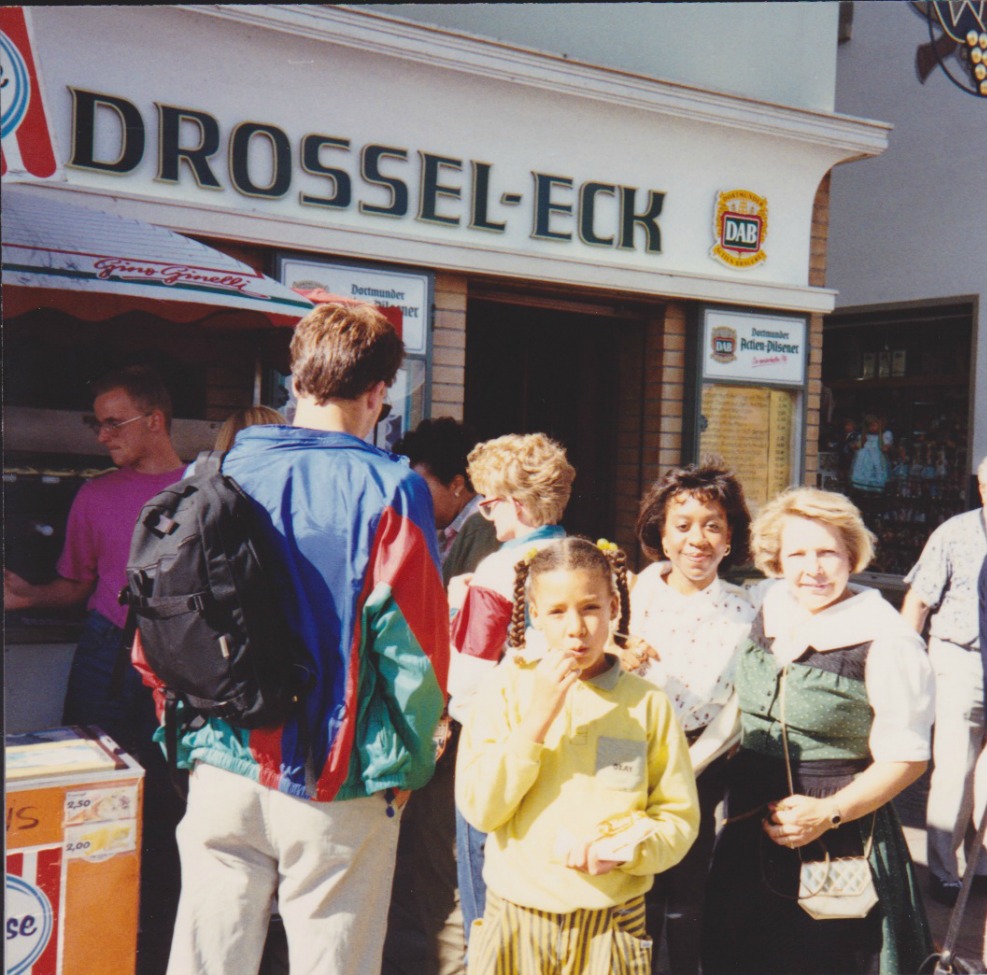
Somewhere in Germany

Trip to Germany. For my 16th birthday, my parents gave me a choice to take drivers’ ed. in the summer and get my driver’s license or to go to Germany with my mom to visit my brother. It was a no-brainer for me; I went to Germany. It was the first time I had been out of the States, and it opened up a whole new world for me. Never again would my world be small and confined; there was a big and exciting world for me to explore.

Seed Planted to Be a Missionary. When I was 16, a faithful and prayerful person from the church in which I grew up told me that God was calling me to be a missionary. It totally freaked me out! That was the last thing I wanted to do. Life went on, and I forgot about this person’s words until I started my missions discernment process a couple of years ago.

Led to Church Home. I was in the choir when I was in high school, and each year we would perform Handel’s Messiah with the Nashville Symphony. My junior year, we couldn’t have our dress rehearsal at TPAC, so we practiced at a local church. I remember walking into the church, thinking it was the most beautiful church I had ever seen. I had no idea what type of church it was; I didn’t even know in which part of the city it was located. I just thought it was beautiful. Six years later, I became confirmed in this church’s denomination and four years after that, I visited this church in my quest for a church home, unaware that I had been there ten years earlier as a 16-year-old. It was St. George’s, my new church home.

So, as you can see, God was doing some major work behind the scenes of my 16-year-old life, and I had no clue. It’s amazing to look back now and reflect on how these pieces have all come together.

No-Go Books

As I have mentioned several times, my books are going to be the hardest thing for me to part with; but upon a quick glance-through, there are some I definitely plan to leave behind.

Top-10 Books I Won’t Be Taking with Meno-go books

10. Moby Dick by Herman Meville (I never liked this book. I don’t know why.)

9. Henry IV, Part One (only because it has a big rip through the cover)

 8. Doctor Zhivago by Boris Pasternak (I have two copies. I’ll be taking the hardback with me. Had you fooled, right? Doctor Zhivago is one of my top-three favorite books of all times.)

 7. Ernest Hemingway’s short story “In Our Time” (I’ll be taking the complete Hemingway short stories with me.)

 6. The Heart of the Matter by Graham Greene (I didn’t like it.)

 5. Decline and Fall of the Roman Empire by Edward Gibbon (It’s full of helpful information but dry and boring as dust. Plus, it has no chapters!)

 4. Reflections on the Revolution in France by Edmund Burke (same as above)

bookcases
two of my three bookcases, not including spill-over books in corners

3. The Stuart Constitution (I was never into parliamentary history.)

 2. Tennessee: A University Portrait (Why on earth do I have this book in the first place? Someone please tell me.)

1. John Calvin: Selections from His Writings (Oh, my, the writings of Calvin. Enough said.)


Who Am I or Rather—Who Will I Be?

Let’s face it, sometimes Jesus’ teachings are hard. Sometimes I wish he didn’t say some of the things he said. Take Matthew 10:37­­-39 (NRSV), for example: “Whoever loves father or mother more than me is not worthy of me; and whoever loves son or daughter more than me is not worthy of me; and whoever does not take up the cross and follow me is not worthy of me. Those who find their life will lose it, and those who lose their life for my sake will find it.”

I have always struggled with this passage; it makes me feel uncomfortable. God wants us to love our families, right? I love my family more than any people in the world. And who wants to take up a cross, to face known or unknown persecution? Perhaps it is verse 39 that I find most troubling: Aren’t we supposed to find and embrace life? If we lose our life for Christ, we will find it? What does that mean? Help!

 Over the years, I have come to a deeper understanding of Matthew 10:37-39. At the core, I think Jesus is talking about priorities. Whom do we love more–our families or him? As a matter of fact, it isn’t a tradeoff. The more we love Christ, the more we love our families and others. Everything falls into order.

As I prepare to move to South Africa as a cross-cultural Christian worker, I sometimes wonder if I will lose my identity. Whom will I be eighteen months from now? two years from now? three years from now? Will I even recognize myself?

For the longest time, I thought Matthew 10:39 referred to physical death: If we were persecuted and died for Christ, we would find life. But I don’t think that is the main thing Jesus is talking about. I think he is talking about giving up our life—life as we know it—for his sake, to do what he has called us to do. This new understanding of the scripture gives me hope and encouragement. As I give up my old way of life, I think I will find myself. I think I will be more fully me, the Yolanda Nicole Corlew whom God created me to be. And that makes me excited.

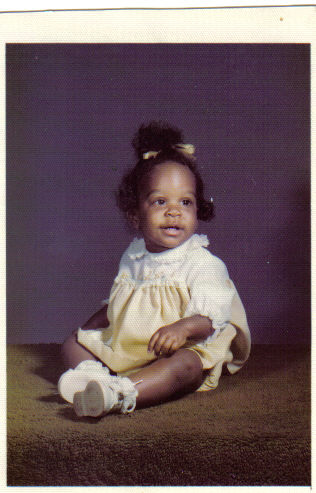
Just  for fun–me over the years:

Baby Nicole
Baby Me
With Dad and Little Sister
way back in the day
Mother's Day 2012
with my beautiful Mom

A New Way of Living

InterdependenceInterdependent: (of two or more people or things) dependent on each other

Interdependent—that is what God is teaching me to be, and it is a hard lesson to learn. For years, I have prided myself on being independent. A child of American individualism, I have taken that concept and have run with it. As an adult, I have made my own way in life. As a singleton, I have had to do everything on my own. I haven’t had to depend on anyone financially—until now.

Support Raising. I don’t think a single missionary enjoys this process. It’s daunting, scary, humbling, and perhaps for some, humiliating. You see, in our American culture, we have been taught not to depend on others for anything, really, except for emotional support. Pull yourself up by your own bootstraps. Make your own way in life. And Frank Sintra’s famous, I did it my way.

As Christians, we aren’t called to live life all alone; we are called to live in community; we are called to live not independently, dependently, but interdependently. And truly, that’s how we are designed to live as human beings. Even if I were independently wealthy, I don’t think being a missionary, solely dependent on my own funds, would be the way to go. When we commit to a project, organization, or cause with our time or money, we become engaged and invested. All of sudden that remote well in Haiti becomes my well too. If you feel compelled to partner with me in prayer and/or finances, my work in South Africa becomes our work in South Africa. Both senders and goers are equally important in God’s eyes.

As usual, Jesus knew what he was doing when he set up this model for proclaiming the Good News: “Soon afterwards he went on through cities and villages, proclaiming and bringing the good news of the kingdom of God. The twelve were with him, as well as some women who had been cured of evil spirits and infirmities: Mary, called Magdalene, from whom seven demons had gone out, and Joanna, the wife of Herod’s steward Chuza, and Susanna, and many others, who provided for them out of their resources” (Luke 8:1-3, NRSV).

A lot of times, I think Jesus’ women disciples get forgotten; but they played an integral role in his ministry by traveling with him and by donating to his cause. If a life of interdependency was good for Jesus and his disciples, it is good enough for me.


Image Source:  thegoldguys.blogspot.com/ or www.lumaxart.com/

What’s In a Name?

To paraphrase Shakespeare, “a rose by any other name would smell the same.”

Super Man

The word missionary invokes all types of images: “super Christians” traveling (flying if they have capes) to a foreign land to do the Lord’s work, hypocrites trying to browbeat natives into western civilization via Christianity (think The Poison Wood Bible), saintly people who never get angry or upset, who don’t have a selfish bone in their body.

I struggle with what to call myself, for I too grapple with the term missionary. I have a South African friend who vehemently dislikes the word because it reminds her of the awful mission schools run by missionaries during the apartheid days. I have other South African friends (both coloured and African) who insist that the term has evolved and no longer carries the negative connotation; on the contrary, it is seen in a positive light. Added to these considerations, I too have stereotypes about missionaries that I need to let go.

Missionary or cross-cultural Christian worker. Hum? These days the later is the more politically correct term. Perhaps it’s the most accurate term; but let’s be real, it’s a mouthful. Maybe I could shorten it to CCCW or C2CW or something cute like C2CW.

What I call myself will probably depend on the audience. As of now, I will continue to use both terms to describe myself. I imagine a term will evolve organically, once I settle into South African life. However, if I had my way, I would use no special term. I’m merely a Christian trying to live out her faith, and I often fall short. God has just called me to live out my faith in South Africa for a few years.

Image Source: moviecultists.com via Cameron on Pinterest

Saying “Yes” to God

It took me quite a while to muster up enough courage to meet with my priest about my sense of call to do mission work. I knew once I confided in him, I would truly have to examine if this was a God-calling or not. I was still scared that it might be. Periodically, over the next year and a half, we would meet together to pray and talk. His gentle guidance and prayerfulness was exactly what I needed. I felt encouraged.

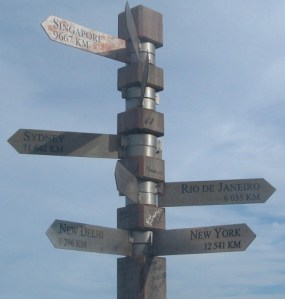
In the fall of 2010, we felt as though it was time for me to move forward, and I entered a formal discernment process at Direction Pole at Cape Point, South Africamy church. For the next eight months, I met with a body of faithful and prayerful parishioners who had committed to serve on my discernment committee to help me determine whether or not God was calling me to mission work. Working with this committee was a humbling experience, as I had to be vulnerable, totally honest about my spiritual journey and life. But having a group of people walk this journey with me for many months has been one of the greatest gifts of my life.

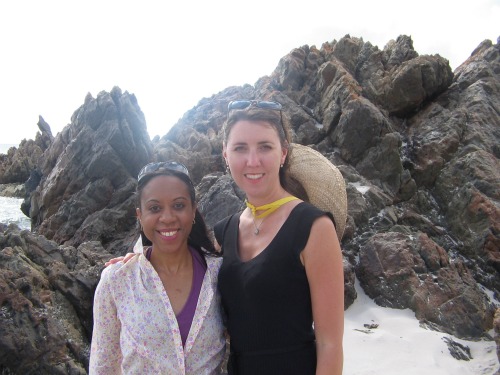
There was a general consensus from the committee that God was calling me to mission work in South Africa, so I continued to move forward and the discernment committee morphed into a sending a committee. There were so many details to work out, and I felt a bit overwhelmed: with which mission agency should I go, and what type of work should I do? Although I had a desire to work with young people and to use my publishing skills, I really didn’t have a clear sense of direction of the type of work God was calling me to do. It took God a while to work out the details, but God was at work behind the scenes in amazing ways. In the words of a new friend, “When we say ‘yes’ to God, he takes over and takes care of the rest.” I feel like this is so true of my journey. Once I said yes to God—“yes, God, I’m willing to go”—God took over, taking care of the details.

I will be going under the mission agency SAMS (Society of Anglican Missionaries and Senders), and I will be serving with Growing the Church, an Anglican organization that serves the entire province of Southern Africa. I will be doing youth development work and working with their media ministries. For more information, check out my blog “Placement Decision: Growing the Church.”

Besides giving you a glimpse of the background story of why I’m becoming a missionary, I hope this discernment series blog will help you take a closer look of what God is doing in your life. What might he be calling you to do? I believe that God has callings for each of us. Some of these are general callings; others are more specific. Some are for life; others are for a season. Perhaps God is calling you to help the elderly neighbor next door, to tutor a child who is struggling with reading, to go on a mission trip, to become a lay reader, to become a foster parent, to become a teacher, priest, or writer. Who knows? Working for God’s kingdom knows no bounds, and God equips us with gifts for a reason. Remember the wise saying of my friend, “When we say ‘yes’ to God, he takes over and takes care of the rest.”

NOTE: This is the third post of a three-part series that recounts my discernment process to become a cross-cultural Christian worker in South Africa.

Nudges

South Africa, Planting Garden
the vegetable garden begins

In the fall of 2007, I returned to South Africa. This time I went on a outreach trip with my church. We helped our “sister church” with their ministries by planting a garden to help support their feeding scheme, in which they feed 200 orphans a healthy meal once a week.

We also helped to build a new home for a family of six who lived in a nearby informal settlement. I have never felt more fully alive as I worked on these projects and interacted with the South African people. I felt a deep-rooted joy like I have never experienced. I was blessed to return to South Africa several more times on outreach trips, and each time I had this same sense of joy. Sometimes it was so hard to come back home. As the plane left South African soil, I would feel as though a part of me was being ripped apart, being left behind in South Africa.

South Africa, Children Eating
some children the feeding scheme serves

Over time, this sense of being called towards something began to transform into a nudge, a gentle prodding to do outreach work in South Africa. But life went on. I worked, played, met another guy, fell in love, and got engaged. Yet in the midst of the excitement and stress of wedding planning, every now and then a voice would speak to my soul, saying, “What about South Africa?”

For many reasons I ended my engagement; and at the same time, I decided I needed to pay attention to this nudge that wouldn’t go away. In the following weeks, I went through an epiphany. I know this sounds nerdy (hey, I embrace my inner-nerdiness), but I distinctly remember spending a few evenings thinking and writing about my life, the American life, and the life we are called to live as Christians: The American way of life is one big cycle. Where’s the meaning in it? Our parents work hard. Why? So that we can we attend good schools, be involved in activities, be well-rounded. Why? So that we’ll get into a good college. Why? So that we’ll land good jobs. Why? So that we’ll marry, have a family, and work hard. Why? So that our kids will attend good schools. . . One reason I broke up with my fiancé was that I felt boxed in, confined, stifled. I was getting trapped into this cycle of life I didn’t want. I wanted out.

Let me be clear, there is nothing wrong with marriage and a family (and yes, I still want these things for myself), but I feel as though God wants much more for us than that—whether we’re married or single. (Yes, even singles fall prey to a similar cycle of life.) I believe God wants us to step outside the cycle and to make a difference in our little corner of the world. Through Jesus Christ, we have abundant life, and God wants us to enjoy it. I think we often sell ourselves short.

After a few weeks of my philosophical and theological musings, I started to carve out some intentional time of prayer. If God was calling me to do outreach work in South Africa, I wanted to be certain. Packing up and moving away from my family, friends, and comfortable way of life to live halfway around the world was no small thing! I wanted to make sure that it was God’s voice I was hearing and not my own. I spent a lot of my prayer time reading “calling stories” in the Bible—Abraham and Sarah, Gideon, Jonah, Jeremiah, the Twelve. I would end my prayer time listening in silence, which was hard for me. A billion thoughts raced through my mind, and I often fell asleep. But I felt I needed this time of silence to listen to God, since I don’t have much silence in my life. It would have been easy for God’s voice to get drowned in the noise of my life.

Turning aside to pay attention to this nudge to do outreach work in South Africa was both exciting and scary. A few days into 2009, I mustered up enough courage to meet with my priest. “I believe God is calling me to be a missionary in South Africa,” I said.

NOTE: This is the second post of a three-part series that recounts my discernment process to become a cross-cultural Christian worker in South Africa.

Wrestling in the Mist


@ Pringle Bay (SA) with BFF

My first and only international business trip took me to South Africa over the new year of 2006-2007. My best friend Anna got to go with me. It was a magical time. I felt a soul connection with South Africa; it was a feeling like I have never experienced before in my international travels. On the last night of the conference, I remember looking up at the stars and feeling as though I would return someday to South Africa, but I didn’t know when or how.

In the spring after I returned home, I entered into a season of restlessness and spiritual wrestling. I recently broke up with my boyfriend, and I was angry. I was being considered for jury duty for a capital murder case and that process made me question my long-held beliefs about capital punishment and our justice system. I had a lot of questions for God, big questions: Why doesn’t God bring the right man in my life? How could a loving God allow so much injustice in the world? Why are some people born into environments of unimaginable abuse and poverty with no way out, while others are born into loving families and communities? I kept thinking about the poverty I saw in South Africa, the young man in Nashville who was about to be tried for his life. I was frustrated, angry, and having serious doubts of faith. I wanted answers from God. I was miserable, and I was making everyone around me miserable. Looking back, I think this crisis of faith was much worst than I thought at the time; it scares me to think about how close I was to throwing in the towel, to walking away from God.

Thankfully, God is much more persistent in his relationship with us than we are in our relationship with him. God doesn’t give up on us. He used some key people in my life, including my dad, to help me get through the time of wrestling. Like Jacob of old, I believe I emerged stronger in my faith. I never did receive answers to my questions; but with God’s help, I decided to trust God anyway. I am learning to live with the questions.

Funnily enough, once I came to this point in my faith journey, I started to have a sense of being called towards something. I didn’t know what, but I felt as though God was calling me towards something, to do something. It was a time of mistiness, but I felt warm. It was a time of uncertainty, but I felt hopeful. I was no longer scared.

NOTE: This is the first post of a three-part series that recounts my missionary discernment process.

Bon Voyage–in Less Than a Year

indigenous flower
an indigenous flower of SA (Please don't ask me the name!)

“Hello, Short-Timer,” greeted a colleague as we walked to our cars after work today. “When do you leave us?”
“Next . . . in January,” I replied.

Suddenly, it hit me. I have less than a year before I move to Cape Town! As I drove home, feelings of excitement, fear, and being overwhelmed hit me like waves. Sometimes I wonder how I am going to get everything done while still working full time and while still trying to have a life. Sometimes it seems impossible; at other times, all the factors of my transitioning life seem to operate like clockwork.

So why am I going through all this bother? Why am I giving up most of my material stuff, my way of life, my comfort zone? Why am I leaving my family and friends to move literally across the world? I think these are the questions most people really want to ask when they ask me, “Why are you becoming a missionary?” At times, it is even hard for me to imagine a life without Starbucks and my iPhone.

Since this blog is about my journey to become a Christian cross-cultural worker (missionary), I thought it might be helpful and interesting (and perhaps entertaining) to hear part of the backstory. So in the next couple of weeks, I plan to start a blog series that tells about my discernment process, how I was able to discern God’s call to mission work.

Stay tuned.