Of people begging at the robots (traffic lights), asking for money, trying to sell me things or collect my trash.
Of singing worship songs in languages I don’t understand or can’t pronounce.
Of people having difficulties understanding me or of my having difficulties understanding them because of
1st South African Cheesecake
our accents.
Of the time it takes to bake any of my favourite things because I have to convert the measurements (sometimes twice) or hunt around for ingredients that are hard to find.
Of feeling pulled in many directions, from people, from projects, from commitments that demand my time. Sometimes I just want to do what I want to do. Sometimes I want space. God, could you please place me in timeout?
Of the use of archaic words, such as “whilst,” in everyday English.
Of trying to find the balance between a relational culture and the reality of time constraints and deadlines.
Of seeing the worst of American culture imported to this beautiful country, giving South Africans a warped view of my country and heritage.
I’m not unhappy. I still love my life and work in Cape Town; but even in the best of times and in the best of circumstances, cross-cultural living can be challenging.
When I was younger, I used to think that God would call me to do something that I would totally dislike. Even worse, I thought he would call me to live in a way that would run contrary to how I was wired. I was so wrong, having a warped concept of God’s love for his children and a lack of understanding of his desire for us to live an abundant life. God has equipped each of us with certain gifts and talents in order to use for his glory, for the general good, and for our enjoyment. I don’t think he would call us to live in a way that was contrary to how he made us.
A few years ago, I had the pleasure to meet Emanuel Ax, one of my favorite pianist.
This is how I see it: The kingdom of God is like an orchestra, and each one of us is gifted to play a particular instrument. God, the conductor, wouldn’t call a violinist to play percussion; but God, at times, would stretch the violinist out of her range, training and disciplining the violinist to become the best violinist that she can be and thus helping the orchestra to become the best it can be. At times in our lives, God may call us to play out of our range; but I don’t think he would call us to play an instrument that we aren’t equipped to play.
I see this reflected in my life in South Africa. God has definitely called me out of my comfort zone, but I am still living a life that complements my nature. I live in a beautiful city, not the bush. I am able to use my gifts and talents in youth ministry and publishing to help the church, instead of being asked to use gift sets that I don’t have, such as planting a church.
What are your thoughts about God’s work and call in our lives? What instrument do you play in God’s orchestra? I would love to hear your thoughts.
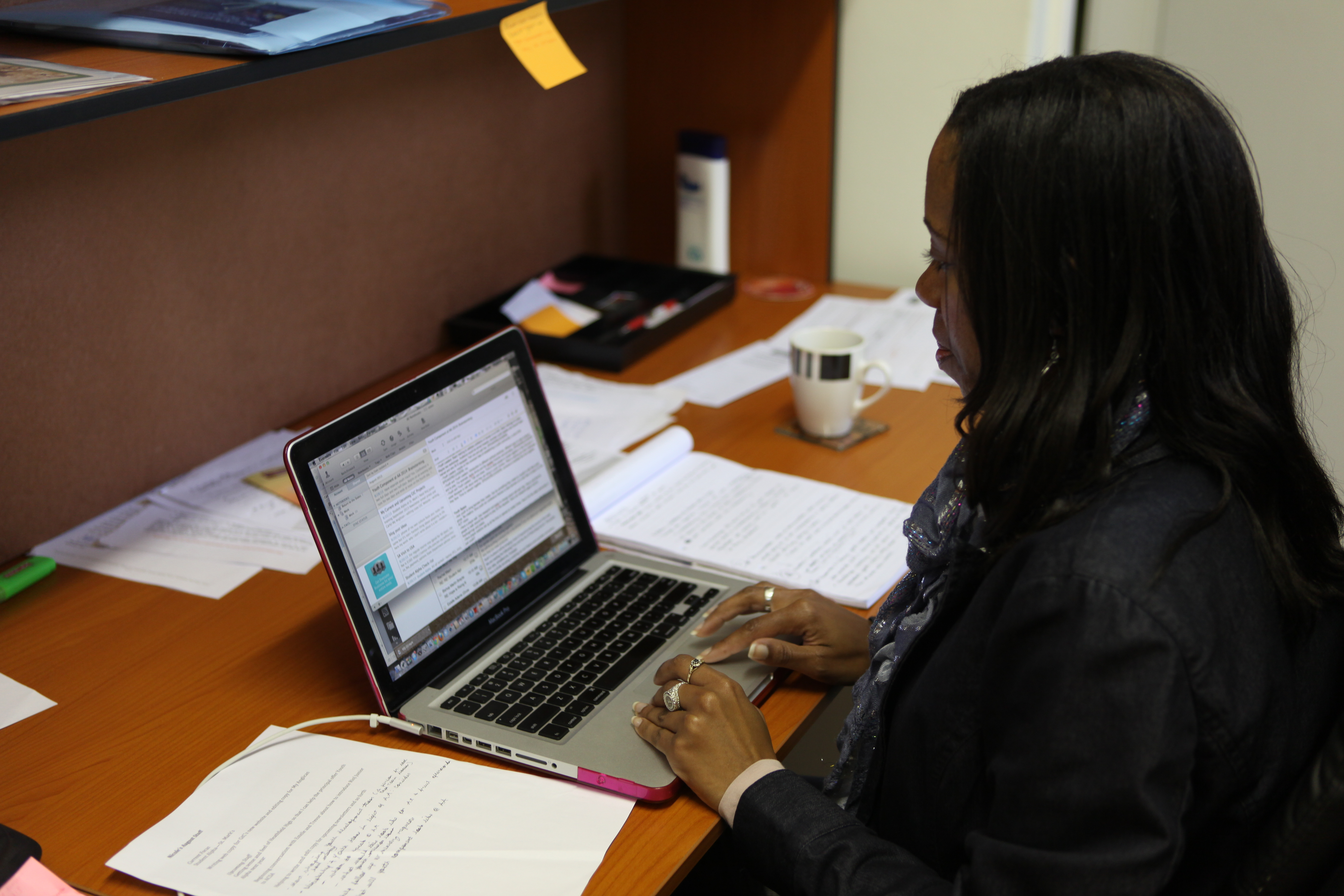
I wonder if people wonder why I don’t write more about work. It’s an easy explanation. Although I love my work and find it very fulfilling, my day-to-day work often takes the form of emails, phone calls, writing, editing, planning, and coordinating projects. The details of doing such things are just not exciting to write about, but the fruit of the work is very rewarding.
A couple of weeks ago, I was having a Skype conversation with a good friend who is a missionary in France. Neither one of us is a “conventional” missionary, and we were talking about the challenges our callings pose and the freedom they give. Our world has changed a lot, even during our short lives; and the way of doing missions has changed too.
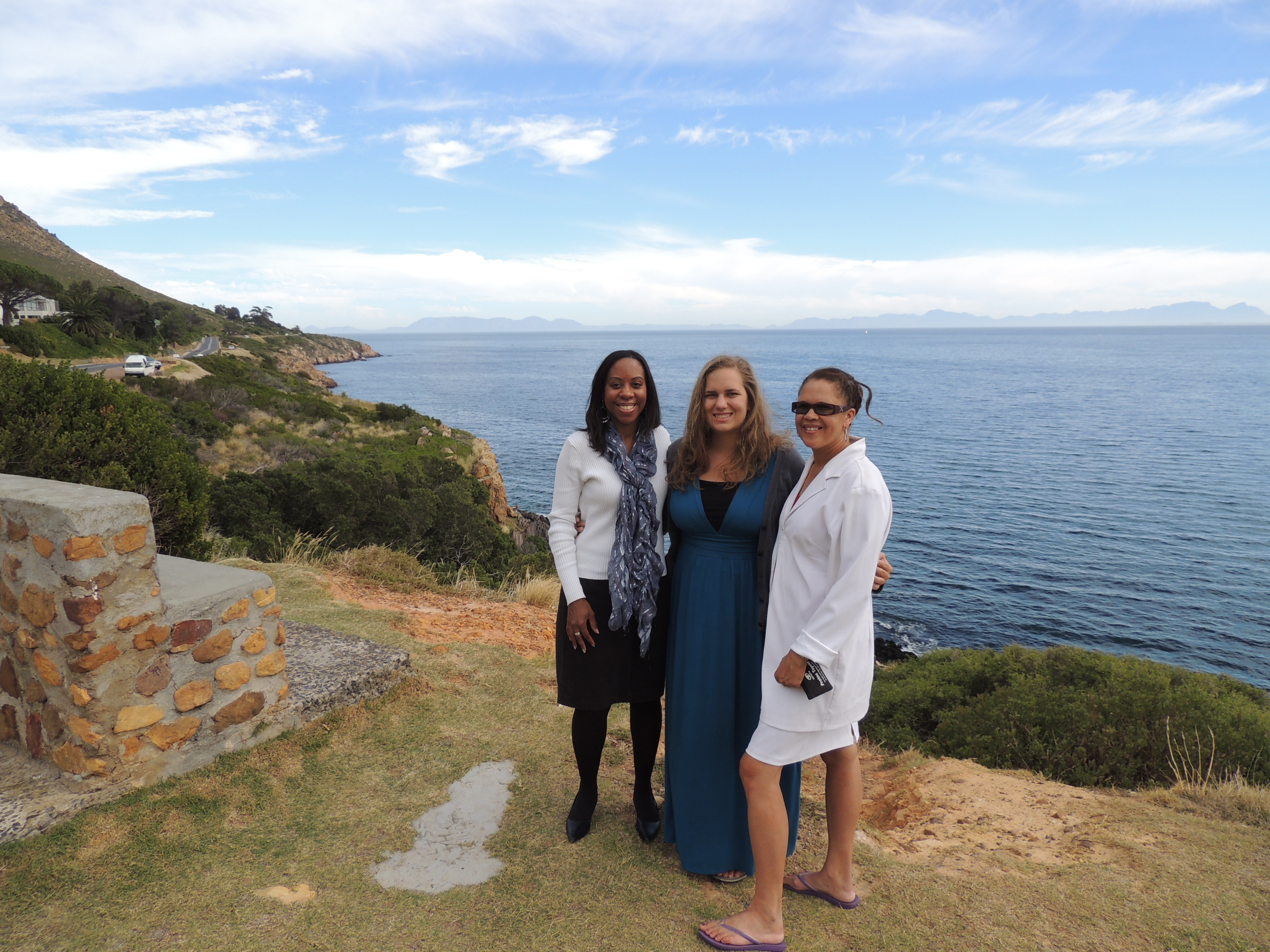
blown away at staff retreat in Hermanus
It’s kind of exciting being a missionary in the early part of the 21st century. It is like God has unleashed his creativity, encouraging and calling people to use their gifts and talents, regardless of what they might be, to help build his kingdom. In my case, I’m working with an organization, Growing the Church (GtC), that helps the Anglican Church of Southern Africa to grow in numbers and spiritual formation. As my work at GtC evolves, I am beginning to understand that although most people living in the countries that make up the province may be Christians, many of them have not been discipled well, mainly because of a lack of resources and knowledge. I feel privileged and honored that I can use my gifts and talents in youth ministry and publishing to play a small role in what God is already doing in our province.
I’m waffling over whether to click “publish” or not. Dare I—or not? I’m a bit embarrassed to publish this post; but as I said from the beginning, my blog will reflect my experiences of living cross-culturally. I won’t gloss over difficult situations or paint things in a rose-colored lens. Yet what I have written about is very first world. Even if my American and South African friends can’t relate, I think they will respect my honesty; and I know they will love me all the same, so here goes…
Budget Man puts the squeeze on iPhone.
Ever since I arrived in Cape Town, I have been borrowing my boss’s spare mobile phone. It was time for me to get my own phone, and I had my heart set on the iPhone 5. Earlier this year, a local carrier had a good deal for the iPhone 5; but I hadn’t been in the country long enough to have all the required paperwork to get the phone on contract. Months later, when I did have the paperwork, the deal had ended and the iPhone 5 was way out of my budget. Ok. I thought. I’ll get the iPhone 4s. Well, it was still out of my budget, but I tried my best to justify it: It will sync with my laptop and tablet. I love the iPhone; I’m familiar with it. I can use several apps to stay in touch with my family. I need it to stay in touch with my family.
I spent several weeks researching all types of smart phones and looking at several local carriers, trying to find the best deal. I crunched numbers, trying to squeeze the iPhone 4s in my budget. I agonised over whether or not to purchase the phone or to buy a certain android phone, which was in my budget. (Gasp—I can’t go droid!) I was fretting about what to do. Finally, I accepted that I couldn’t afford the iPhone, and I began to pout. A week ago, when I was having a pouty conversation with God, I felt God say to me, Get a grip. You are whining over stepping down from a Mercedes to a BMW, whereas most people are still riding along in a horse and buggy.
Ouch, God. That hurt. But God got my attention. Over the next few days, I did a lot of soul searching. I realized, as ridiculous as it sounds, I had a lot of my identity tied up in Apple. I love Macs, and I am an “Apple person;” but somewhere along the way, my admiration for this product line became a way in which I defined myself and that wasn’t good.
Wrestling with my phone dilemma brought me face-to-face with the core of my problem; in many respects, I have been trying to hold on to the lifestyle I had in the States—and that’s impossible. South Africa is not the USA, and I make a fraction of what I earned at my old job in the States. And even if I could create a mini-USA lifestyle bubble for myself, it wouldn’t be the right thing to do, especially as a missionary.
But it’s hard. I feel the tension of going from a first-world country to a developing one. At times the tension is in the background; other times, it is at the forefront–but the tension is always there. I guess it is a part of living cross-culturally. It’s a challenge to know what to hold on to and what to let go. I’m embarrassed that it was so difficult for me to let go of something so trivial as a phone, but it was hard. On the flipside, some things are worth holding on to. Recently, I have come to terms that I need to join a gym, as it isn’t safe for me to go on walks by myself and as public tennis courts are non-existence. Physical health is vital to my emotional, mental, and spiritual health; and I am feeling the lack of exercise from which my body is suffering. This is the most unfit I have been in my adult life. Being fit is something worth holding on to; but the phone, I had to let go—and that’s OK. Steve Jobs would understand.
“But you moved to Africa to be stretched out of your comfort zone,” my friend said. Yeah, but, I thought, I can take only so much change. I wish God would place me in “time out” for a while.
In a few weeks, I’ll be traveling to Tanzania in order to be trained in Rooted in Jesus Junior. As I read through the training manual, I only get more excited about my trip. I’m thrilled and honored that I will be trained in this powerful and transformative discipleship course for older children and young teens and that I will be bringing back this course to South Africa so that we can introduce the course to Sunday school and confirmation teachers. People in South Africa are already asking for training, so it’s quite exciting.
At the same time, I’m a bit nervous about the trip. I will be totally stretched out of my comfort zone, as I travel in rural Tanzania. In a way, I feel as though I will be hurled out of it. This American city girl is about to get the American city girl knocked out her. I will be traveling with a training team from the UK, and we have to bring our own water and loo rolls (toilet paper). In one of the places, we’ll be using something called a “long drop toilet.” (I think I’ll let this one surprise me.) I had to get several inoculations for the trip, and I’ll have to take malaria medicine and sleep under a mosquito net. I have been invited to preach at one of the parishes; and this, in a way, makes me more nervous than anything. Talking with my friend about my anxiety led to the snippet of conversation with which I opened this blog post.
I have no doubt that my trip to Tanzania is going to change me in some profound ways. I keep hearing about how hospitable the Tanzanian people are, and I know that I will be met with some mind-blowing hospitality. I look forward to visiting Rooted in Jesus Junior groups and to meeting the children. I look forward to being trained in the course and to helping out with the training during the second week. I’m praying for God’s direction as I start planning my sermon.
Yes, I’m being stretched out of my comfort zone. Like physical exercise, it is tiring and at times painful; but it is also exhilarating.
Yay! Tomorrow I get to go home. I thought as I packed up for the next leg of the recent church trip. On the St. George’s trips to South Africa, we spend our first week in Johannesburg and then fly to Cape Town on Friday. Normally, when I repack for this leg of the trip, I think, I get to go to Cape Town tomorrow! This time I thought, I get to go home. Yay! I miss the mountains and the sea. I miss my flat and my bed. I miss my friends. I miss home.
This line of thinking is a good sign. Cape Town is indeed becoming home to me. However, I was a bit unnerved about this first feeling of home, and I fought against it on the flight to Cape Town and for several days afterwards. Nashville is where my family and friends live; it is where I grew up. It’s home, not Cape Town.
And yet Cape Town is feeling more and more like home, and that’s good—I keep telling myself, although a part of my heart stings. I have had several feelings of “home” during the past month—playing board games on Easter afternoon with the young members of the Adams family, my dear friends, visiting a friend who had a recent operation, routine grocery shopping at the local shops, curling up with a good book on a quiet evening.
Yet it’s ironic; the more I live into life here and the more Cape Town becomes home to me, the more homesick I get for home. I feel the tension. At times it’s intense. At times I want to go home and hug my family. I miss them.
Friends via Nashville Connections
It’s hard living in the in-between of two homes, but I knew it wasn’t going to be easy. It’s a natural part of adapting to cross-cultural living. I look forward to the day when I can call both cities home without an ache in my heart or at least without the intensity of the ache.
As believers in Jesus Christ, living in the in-between is nothing new. It’s what we’re called to do, being dual citizens of heaven and earth. And at times, that type of living is difficult as well. It is also a tension.
I’m praying for the courage to live with the tension.
Last Thursday, I had the honor and privilege to attend Archbishop Tutu’s Templeton Prize thanksgiving service at St. George the Martyr Cathedral. It was a beautiful and joyful service dotted with amazing music by the Cape Town Opera Voice of the Nation Ensemble. I think all of our hearts leapt when Archbishop Tutu started dancing with the ensemble.
The archbishop accepted the award on behalf of the people of South Africa, saying it was the people’s award. Then he gave one of the most moving speeches I have ever heard. Speaking from the heart and walking in front of the nave of the church, Archbishop Tutu recounted parts of “the struggle” (South Africans who fought against apartheid refer to their fight as “the struggle”) as he came to the heart of his speech, imploring, “What has happened to us? What has happened to us? What has happened to us? . . . God is weeping.”Speaking of the transition to democracy, the archbishop continued, God was proud of us. He was going to show us off as a people who could live together in harmony despite our cultural differences and as a people who would share with one another what they had. “But what has happened to us?”the archbishop asked, referring to the high level of violence in South Africa, especially violence against women, and referring to South Africa’s dubious distinction of being the number one country in the world with the widest gap between rich and poor.
As Archbishop Tutu walked in front of the nave, crying out from the heart, “What has happened to us?” I no longer saw him as the renown public figure and global icon of peace. I saw him as a beloved grandfather asking his children and grandchildren, all of us in the service and in South Africa, “What has happened to us as a family?”
The archbishop ended his speech by challenging all of us to reclaim the spirit of ubuntu, which to me can ultimately be summed up with Jesus’ two great commandments: Love the Lord God with all of your heart and mind, and love your neighbor as yourself. If we did this, we would be living out ubuntu.
Archbishop Tutu’s words have challenged me in a profound way, and I am more determined than ever to try to live a life of ubuntu, both here in South Africa and in the States when I return home. Want you join me by accepting the archbishop’s challenge to reclaim (or claim for the first time) the spirit of ubuntu?
I can hardly believe it, but I have been living in Cape Town for nearly six weeks. Saturday will mark the milestone. All is going well. I continue to work hard on the Anglicans Ablaze study guide booklet. I’m beginning to meet with local and provincial youth leaders so that we can start building relationships. I participated in my first Rooted in Jesus training, and on Saturday I will start the Mission Shaped Ministry course, in the hopes that Growing the Church will have the opportunity to help start a Fresh Expressions of Church at a local university.
On the home front, I have moved into a lovely flat, opened a bank account, subscribed to an ISP, and started grocery shopping on my own. I bought a car earlier this week, and I’m beginning to drive. (Today I drove on the motorway for the first time!) I am spending a lot of time with my South African friends and getting to know them and their families better. I enjoy this time the most, and I am learning loads about South African culture from them.
I am also beginning to miss the familiar—my family, my friends, my church, food, the shops, Starbucks, an active social life, work that was routine, tennis, kickboxing, walks around my neighborhood, grocery stores with aisles of choices, houses that aren’t gated in with fences and barb wire and locked up with burglary bars, walks in the parks, the freedom to come and go as I please by myself, my puppy-nephew, taxis that abide by traffic rules, words spelled with z‘s and not s‘s.
There are many things that I love about my new culture; others I find rather strange. No doubt my feelings indicate the birth pangs of culture shock, which is just a natural part of the process of living in another country. During my missionary training at MTI, we were warned about the phase of culture shock and were prepped for it. I think being aware of this phase is key and will make going through the process much easier than if I didn’t know otherwise. The most important thing about culture shock is not getting stuck in it. Equally important, I believe, is not blitzing through it, trying to escape the discomfort. I’m praying for the courage to live into the culture shock, to acknowledge the discomfort, to reflect deeply on my home culture and on my adopted culture, to emerge on the other side as a person who can live healthy and happily in both of her worlds.
Well, it has been real. We knew this day was coming, and it has. Actually, it came. I moved out two months ago. Have you even noticed? You probably haven’t missed me. I haven’t missed you either, well, maybe just a little. But I definitely haven’t missed your waking me up at 6:20 in the morning, cracking your walnuts or whatever else you squirrels eat for breakfast. I haven’t missed your scurrying around the rafters, scaring me half to death at night. I certainly haven’t missed your eating my tomato plants or digging up my petunias.
I have to admit, as far as squirrels go, you’re pretty good. And yes, I have even developed a little soft spot for your kinfolks. I shudder ever time I pass one of your cousins splattered across the Cold Gray River (By the way, we humans call it a road). I nearly had a wreck the other day, trying to avoid hitting one of your kindred. He couldn’t make up his mind to cross the road or not, kept darting back and forth. He was kind of squirrely. Ergh, sorry.
Scrappy’s 2011 Pumpkin
So I have learned a little bit from you. Will you miss me? Probably not. I think you are still mad at me because I didn’t put out a harvest pumpkin in the fall; but as I said, I moved. I moved. Don’t get mad at me because you didn’t have any seeds to eat. To be honest, I got tired of fighting over the pumpkin with you each fall. Somehow you always won the battle. I think you fought dirty.
What? I don’t know if there are any squirrels in Cape Town. There are plenty of baboons, though. No! I won’t take one of them as a roommate. They are too big and mean. Are you trying to get me killed or something? The only furry roommate I ever plan to have again is a d.o.g. Yes, I know you hate dogs, but they are g.o.o.d. Stop waxing wroth. If you try being nice to them for a change, perhaps they will stop chasing you.
I hope your new roommate will be half as good to you as I was. I don’t think you realized how lucky you had it. What? I was lucky? Hum, I don’t know about that. But I admit, we did have some good times together. I will miss you.
By the way, why don’t you ask out Skiffy, the cute little squirrelette who lives in L-25. She likes you, you know. Yes, for real.
Adieu, my little friend. Mind the Cold Gray River.
Affectionately,
Nicole
“Scrappy” was the squirrel who lived between my ceiling and rafters. He had quite a personality and became a little celebrity among my friends and me. He has kindred all over Nashville. Perhaps you have seen one of them. Since my blog posts have been so serious of late, I thought I would shake things up. However, Scrappy is most offended by this; he finds no humor in his current situation.
When I first came to training, I didn’t know what to expect. I have been pleasantly surprised. Each day gets better and better. I’m being stretched and challenged to grow both spiritually and emotionally. But more than anything, I love the amazing sense of community among my fellow missionaries. Although we have known one another only for a couple of weeks, there is camaraderie, fellowship, and loads of fun. It’s a joy to talk with people who are experiencing the same things that I am. My new friendships are a gift.
Playing with new friends at the Olympic Training Park
We spent most of last week talking about stress and rest. We were challenged to look deeply into how we handle stress and were encouraged to cultivate healthy ways to cope with stress. The life of a missionary (especially at first) is one of elevated stress. In my new life everything will be new; and although that is exciting, it is also stressful. For example, I will have to learn how to grocery shop, bank, and drive on the left side of the road. Grocery shopping, banking, and driving are things I can do in my sleep back home (well, maybe not drive)), but even the most mundane tasks will become stressors in my life as I have to relearn them. I need to be prepared, and awareness is the first step.
We also spent significant time on the need to practice Sabbath rest. I was reminded of what we talked about in my huddle group (small group) at church—scripture teaches us to work out of our rest. Ironically, before I said “yes” to God’s call to serve in South Africa, I used to have a healthy rhythm of work, rest, and play. But the past two years have been filled with preparations, and I fell out of that rhythm. I am determined to create a new rhythm of work, play, and rest that will fit my new cultural setting. Living a balanced lifestyle will make me a better team member, a more in-tuned daughter, sister, and friend, and a healthier child of God.
“Are you tired? Worn out? Burned out on religion? Come to me. Get away with me and you’ll recover your life. I’ll show you how to take a real rest. Walk with me and work with me—watch how I do it. Learn the unforced rhythms of grace.”













 Adventures in Living